Every year on 1 and 2 November, Mexico sets a place at the table for the people it has lost. Day of the Dead, or Día de Muertos, is not a sad holiday and it is not Mexican Halloween. It is a homecoming.
This year the community at Mi Casa Coliving in Puerto Escondido built their own ofrenda, the home altar that welcomes the dead back for a night. Mi Casa is run by two Mexican women, so the guests did not watch the tradition from the outside. They went to buy the flowers, pulled the petals, laid the cross and lit the candles together. Here is what that looks like, what every item on the altar means, and where else in the world early November is a time to remember.
"Día de Muertos is celebrated on November 1st and 2nd and is one of Mexico's most meaningful traditions. It's a time when we believe our loved ones who have passed away come back to visit us. To welcome them, we prepare altars at home with cempasúchil (marigold) flowers. Their distinctive scent is believed to guide spirits back home. We also light candles and leave out food, drinks, photos, and other things our loved ones enjoyed in life. There are many ways to celebrate: from big festivals and family gatherings to creating an altar at home or visiting the cemetery. Every family has its own traditions, and there's no right or wrong way to remember those we've lost. At its heart, Día de Muertos is about celebrating life and keeping the memory of our loved ones alive."
The Mi Casa team
What is Día de Muertos?
Día de Muertos is a Mexican tradition, held on 1 and 2 November, in which families welcome the souls of their dead relatives back home for one visit a year. UNESCO added it to its list of the Intangible Cultural Heritage of Humanity in 2008, under the name "Indigenous festivity dedicated to the dead" (UNESCO).
The tradition blends Indigenous Mesoamerican beliefs about death with the Catholic calendar of All Saints and All Souls. In most of Mexico, 1 November belongs to the children who died, the angelitos, and 2 November to the adults. Many families start preparing several days earlier, and in Oaxaca the celebrations often begin by 31 October.
You will hear both "Día de Muertos" and "Día de los Muertos." Both are correct. Día de Muertos is the more common form inside Mexico.
Día de Muertos on the Oaxaca coast
Oaxaca is one of the states most closely tied to Day of the Dead, and most guides send you straight to Oaxaca City for its parades and cemetery vigils. Puerto Escondido, on the Pacific coast of the same state, offers something quieter: home altars, family visits to the local cemetery, and a beach town that is just waking up for the dry season.
That timing matters if you work remotely. According to Mi Casa's listing, November to May is the dry, sunny season in Puerto Escondido, while June to October is greener and quieter with afternoon rain. Arriving for Día de Muertos means you catch the tradition and the start of the best months on the coast. If you are planning your winter too, our guide on where to spend Christmas, New Year and Chinese New Year as a digital nomad picks up right where November ends.
How the Mi Casa community built their ofrenda
The Mi Casa ofrenda was a shared project, built step by step by the hosts and guests together. Here is how it came together.
1. Buying the cempasúchil. The day started at a local flower shop, coming home with armfuls of orange marigolds.
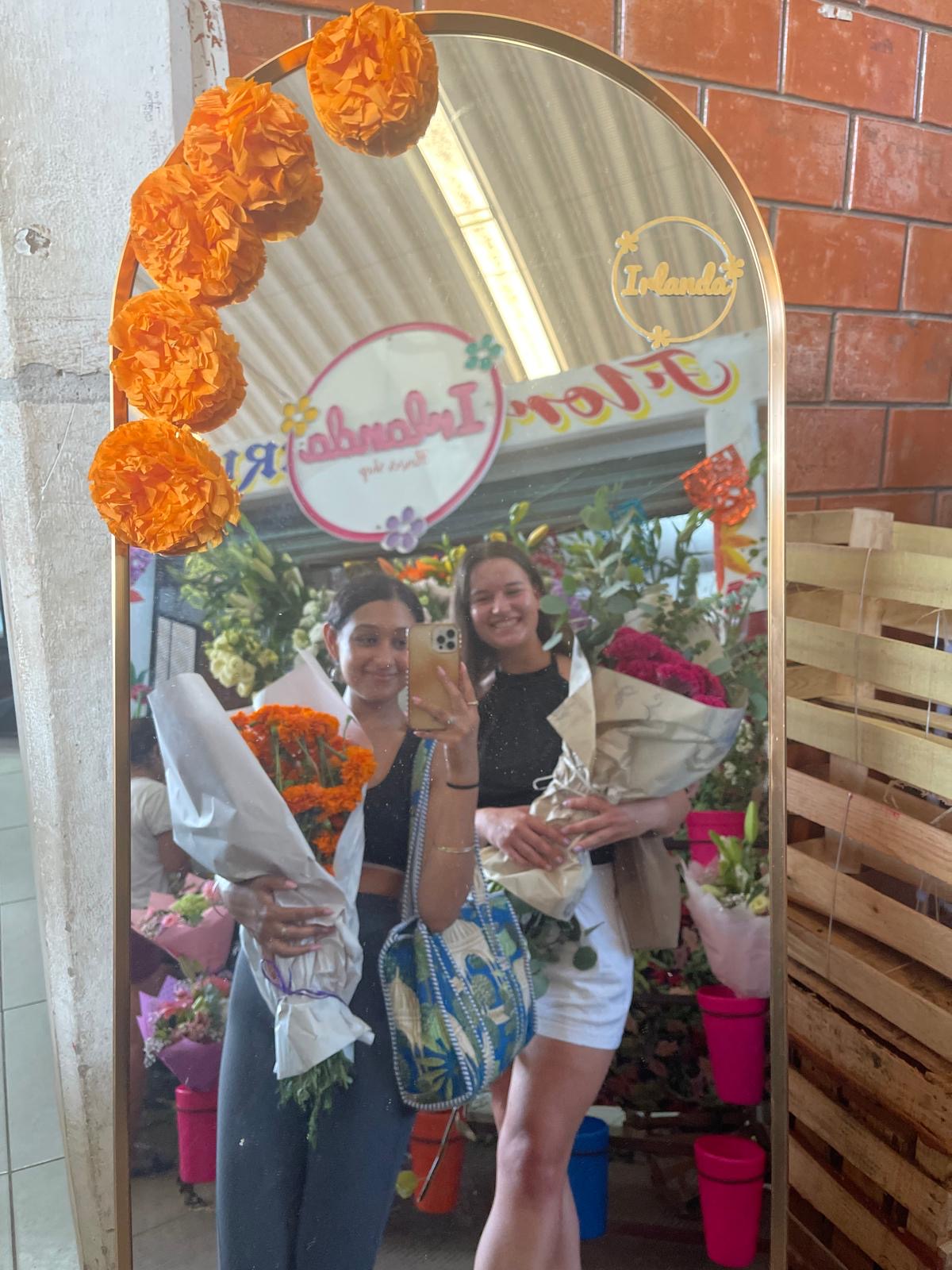
Bringing home cempasúchil from a flower shop in Puerto Escondido, with the Mi Casa community
2. Preparing the flowers. Back at the house, the stems were cut and the petals pulled by hand, sitting on the tiled floor of the hacienda style living room.
3. Laying the cross. The loose petals became a cross on purple cloth in front of the altar, a common way to mark the spot where the souls arrive.
4. Building the altar. Boxes and tables were stacked into levels, covered in purple and gold cloth, then filled with candles, flowers, photos and the things each person wanted to offer.
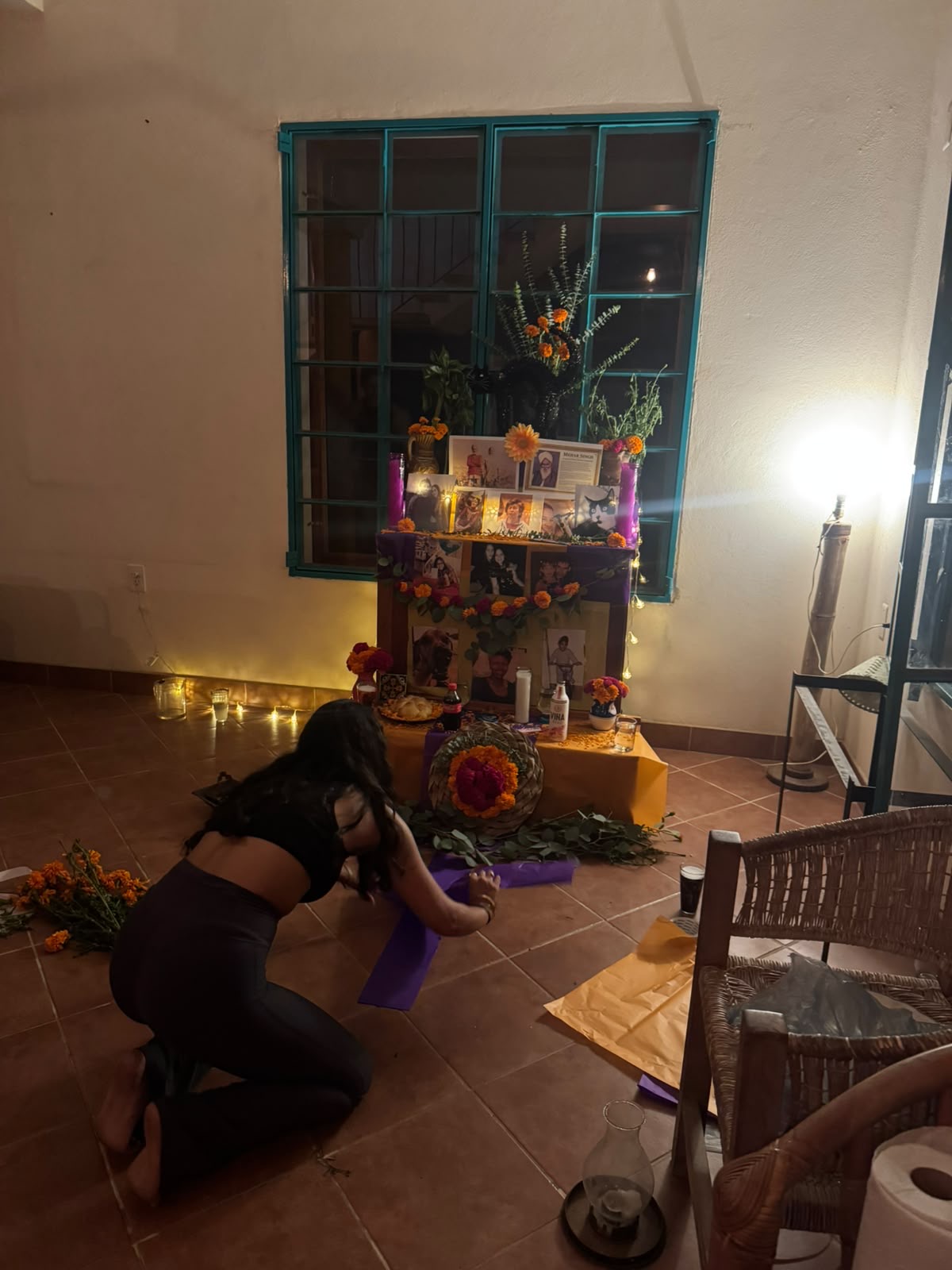
Final touches on the ofrenda at Mi Casa Coliving, Puerto Escondido
5. Lighting it up. By nightfall the candles were lit, with guitars and clay pots framing the altar and photos of loved ones at its center.
What goes on an ofrenda (and what it means)
An ofrenda is a home altar built to welcome the dead, and every object on it has a job. These are the most common elements:
Cempasúchil (Mexican marigold): the name comes from the Nahuatl word cempōhualxōchitl, often translated as "twenty flower." Its strong scent and bright color are believed to guide the souls home, which is why petals are often scattered in a path or a cross.
Candles: light the way for the souls, one is often placed for each person being remembered.
Photos: show who the altar is for, so each soul recognizes its place.
Water: quenches the thirst of the souls after their long journey.
Salt: a symbol of purification, placed in a small dish.
Pan de muerto: a sweet bread made only for this season, decorated with dough shaped like bones.
Favorite food and drink: whatever the person loved in life, from mole to a cold beer or a cup of coffee.
Papel picado: cut tissue paper banners that move in the air, a reminder of how fragile life is.
Copal: a tree resin burned as incense to clean the space and guide the souls.
Personal objects: a guitar, a hat, a book, anything that says "this is yours."
Many altars have several levels, often two or three, that families explain in different ways, for example earth and heaven, or earth, purgatory and heaven. As the Mi Casa team puts it, every family has its own way, and there is no wrong one.
Why Día de Muertos feels different in a coliving
In a coliving, Día de Muertos becomes something rare: a room full of people from different countries building one altar together. Because there is no right or wrong way to remember, anyone can bring a photo of a grandparent or a friend from home and place it next to the others. Remembering someone with people you have only known for a few weeks can feel surprisingly close.
That is the quiet strength of a good coliving. You are not a tourist watching a parade, you are a housemate invited into a tradition by hosts who grew up with it. And like most Día de Muertos nights, the days around the altar at Mi Casa also meant sharing food and stories with the people who are still here.
How to celebrate Day of the Dead respectfully as a visitor
The simplest rule for Day of the Dead as a foreigner is to take your cues from the locals around you. A few practical points:
Ask before you photograph an altar in someone's home or a family at a grave. Cemeteries on these nights are places of mourning and reunion, not photo backdrops.
Join, don't stage. If you are invited to help with an altar or bring a photo, say yes. It means far more than a costume.
Face paint is fine at festive events, but think twice before walking through a cemetery in full costume while families sit with their dead.
Bring something. Flowers, bread or a candle is a kind gesture when you visit a family altar.
Buy local. Marigolds, pan de muerto and papel picado from local markets support the families who keep the tradition alive.
Coliving in Puerto Escondido: where to stay
All three Coliving Community partners in Mexico are in Puerto Escondido, plus a few more houses that are not listed with us yet. If you want to spend next Día de Muertos (and the dry season after it) on the Oaxaca coast, here are your options.
Mi Casa is a Mexican run coliving in a hacienda style house in La Punta Zicatela, home to the ofrenda in this article. It hosts up to 15 guests, prices start from 620 USD a month, and the community runs three activities a week, including a Mexican cooking class with a family style dinner. The coworking space has eight workstations and Starlink WiFi. Use code COLIVINGXMICASA for 10 percent off when booking directly. You can also hear Fernanda from Mi Casa on our Coliving Community Talk podcast. Official site: micasacolivingpxm.lovable.app
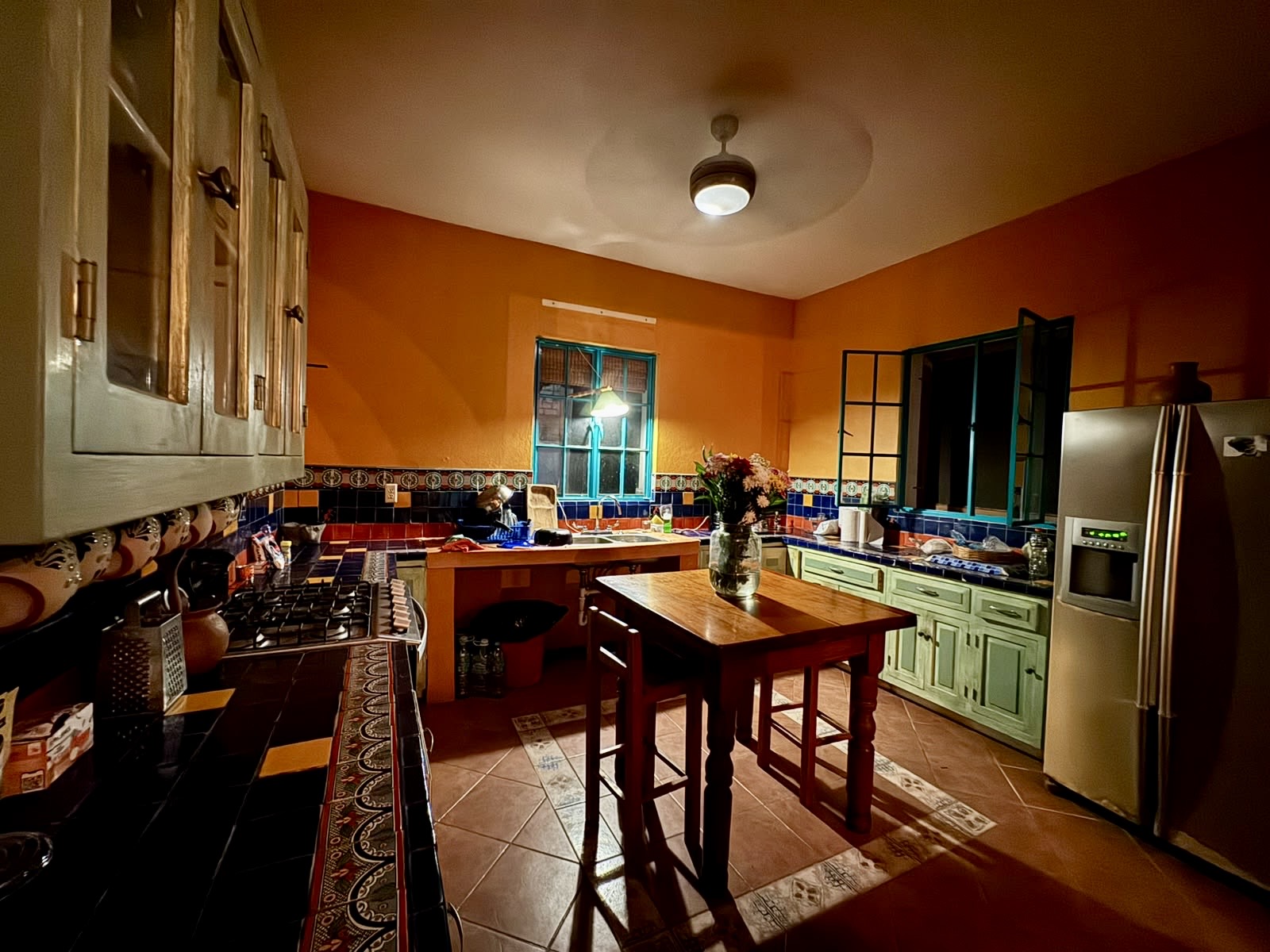
The kitchen at Mi Casa Coliving, home of the weekly Mexican cooking class
Amplitude Coliving is the premium choice, a few steps from the surf in La Punta. It has room for 26 people in 13 rooms, private rooms with ensuite bathrooms, fiber and Starlink internet with backup power, and prices from 1,650 USD a month. Official site: amplitude-coliving.com
Nomadico Colivings runs a Puerto Escondido house open all year, from 749 USD a month, with a community manager, shared dinners and social events. It is a good fit if you like the idea of hopping between Nomadico homes in other countries later. Official site: nomadico.io
More colivings in Puerto Escondido worth knowing
Puerto Escondido has a growing coliving scene beyond our partners. These three are not listed on Coliving Community (yet), but they are good ideas to look at if you want to compare.
Surfbreak Coliving started in Honolulu and opened its second house in Puerto Escondido, a boutique villa in Brisas de Zicatela, a few steps from the famous Zicatela surf. It has a coworking space, furnished private rooms and community managers who run shared meals and events. A Holafly guide updated in May 2026 lists rooms from about 1,200 USD a month, with a pool, Starlink and backup generators.
Casa Flow Coliving and Surf House is a smaller house in a residential part of Zicatela, two blocks from the ocean and about five blocks from Mercado Zicatela. It has 10 rooms, each with a desk and a double bed, WiFi of around 200 Mbps across the property, two full kitchens, and work areas with an ocean view.
Bambú Corner (Casa Consciente) is an eco built coliving of bamboo and adobe in the quiet La Punta and Tamarindos area, about a four minute walk from Zicatela Beach. It collects rainwater, has private rooms with their own bathrooms and outdoor showers, and runs family dinners, excursions and surf sessions. According to the same Holafly guide, a private room costs from about 371 USD for two weeks or 500 USD a month, which makes it one of the most affordable options in town.
See all options on our coliving in Mexico page.
Where else the dead are remembered in early November
Mexico is not the only place where the first days of November belong to the dead. If you are somewhere else this time of year, many of our partner colivings sit right in the middle of their own traditions.
Guatemala: giant kites on 1 November. In Sumpango and Santiago Sacatepéquez, villages build round kites from bamboo and tissue paper, some of them more than 20 meters wide, and raise them in the cemeteries as a bridge to the souls of the dead. Families eat fiambre, a cold salad made only for this day that can have more than fifty ingredients. Both villages are within easy reach of Antigua, where Nomadico Colivings has a house open all year from 890 USD a month. More on our coliving in Guatemala page.
Spain: Todos los Santos and the Castanyada. 1 November is a public holiday across Spain, and many families visit the cemetery to clean and decorate graves. In Catalonia the night becomes the Castanyada, with roasted chestnuts, sweet potatoes and small almond sweets called panellets. That is the season at Wonder House in Barcelona, The Better Neighbors on the Costa Brava, Mas Pujols in the countryside north of Barcelona and Casa Marques 1776 in Cunit. In Valencia, Folks Coliving sits right in Russafa for the holiday.
The Canary Islands: the Noche de Finaos. On the night of 31 October, Canarians gather for the Finaos, sharing roasted chestnuts and stories about the people they have lost. You can join it on Tenerife at Bencomo Coliving or Cactus Coliving Tenerife, on La Gomera at Cactus Coliving La Gomera, or in Las Palmas de Gran Canaria at U32 Sport Coliving and Coliving Casa Alsatia. See coliving in Spain.
Portugal: Pão por Deus. On 1 November, children in many Portuguese towns go from door to door asking for "bread for God" and come home with bread, nuts and sweets, while adults visit the family graves. Our Portuguese partners include Satvana in the Alentejo, Onda Coliving in Peniche, Bela Vista Coliving and Retreat in the Algarve, and Casa Basilico and Homeoffice Madeira on Madeira. See coliving in Portugal.
Italy: 2 November, the day of the dead. Italians visit cemeteries with chrysanthemums on 2 November, and in many regions bakeries sell crunchy "bones of the dead" biscuits. In Sicily, children traditionally receive small gifts said to come from their departed relatives. Just across the strait, Live Local in Southern Italy is in Reggio Calabria, and you will find the same season at La Vita Sukha in Puglia, Tursi Digital Nomads in Basilicata and Nesting Away in Lazio. See coliving in Italy.
Wherever you are, a coliving that runs on the local calendar turns these days from "a holiday when shops are closed" into something you actually take part in. That is a big part of what we mean by seasonal coliving.
FAQ
When is Day of the Dead?
Day of the Dead is celebrated on 1 and 2 November every year. In 2026 it fell on a Sunday and Monday; in 2027 it falls on Monday 1 and Tuesday 2 November. Many families start preparing their altars several days earlier.
What is the difference between Día de Muertos and Día de los Muertos?
There is no difference in meaning. Día de Muertos is the more common name inside Mexico, Día de los Muertos is often used abroad.
Is Day of the Dead the same as Halloween?
No. Halloween comes from Celtic and Christian traditions about warding off spirits, while Día de Muertos welcomes the souls of loved ones home. They happen at the same time of year, but the spirit is very different.
Why are marigolds used for Day of the Dead?
Cempasúchil marigolds are believed to guide the souls home with their strong scent and bright orange color. Their name comes from the Nahuatl word cempōhualxōchitl.
What goes on a Day of the Dead altar?
A typical ofrenda has marigolds, candles, photos of the dead, water, salt, pan de muerto, papel picado, copal incense, and the favorite food, drinks and objects of the people being remembered.
Can foreigners celebrate Day of the Dead?
Yes, and most Mexicans are happy to share it. Follow local cues, ask before taking photos at altars or graves, and say yes if you are invited to help build an ofrenda.
Is it OK to paint your face for Day of the Dead?
At festive events and parades it is common and widely accepted. In cemeteries, where families sit with their dead, keep it low key.
Is Puerto Escondido a good place for Day of the Dead?
Yes, if you want a quieter, home centered Día de Muertos rather than big parades. It also marks the start of the dry season, which runs from November to May.
How much does coliving in Puerto Escondido cost?
Among our partners, prices start from 620 USD a month at Mi Casa, 749 USD at Nomadico and 1,650 USD at Amplitude Coliving. Outside our network, Bambú Corner starts around 500 USD a month and Surfbreak around 1,200 USD a month. Prices vary with season and room type.
How is All Saints Day celebrated in Guatemala?
On 1 November, the villages of Sumpango and Santiago Sacatepéquez near Antigua fly giant kites, some over 20 meters wide, in their cemeteries, and families eat a cold salad called fiambre.
Find your coliving
Want to spend next Día de Muertos in a house that celebrates it with you? Browse all our partners on Find a Coliving, and get exclusive coliving deals in your inbox by joining our community.
